THE MATHEMATICAL MODEL OF
THE BACTERIAL BIOMASS TERMOFLOTATION PROCESS
A. Arzamastsev
Dept. of Physics and Mathematics,
Tambov State University, 392OOO Tambov, Internationalnaya Street, 33 Russia
Keywords: biotechnology, mathematical models, thermal properties, processes.
Abstract: A mathematical model of the temperature flotation (termoflotation) of bacterial biomass in industrial apparatus has been developed. It adequately describes the process of temperature separation of bacterial suspension which includes the Pseudomonas cells and molassa malt substrate. The model analysis will permit to determine the optimal conditions of the process in a complex system: bioreactor - termoseparator. The industrial application of this process is discussed.
1. INTRODUCTION
The microbiological suspensions are known to be characterized by the fact
that they practically do not differ in the cells and culture liquid density
(about 1020-1090 kg/m3) and that they have a small linear cell size.
These peculiarities make it difficult to separate such suspensions by standard
ways, that is in the field of inertial and gravitation forces or by means of
flotation. This problem can be solved using termoflotation technology
(Arzamastsev, 1984).Termoflotation is the process of solid particles transport
into the upper part of the apparatus by means of gas bubbles formed when
suspension is heated up to 60-90 oC. The basic component of the
gasous phase of the bubbles is carbon dioxide (CO2) which is one of
the metabolism products at aerobic cultivation. The diameter of these bubbles
is very small (10-4 m) that enables to flotate the solid particles
having the size 10-6 m. Thus even single bacterial cells can be
separated which is impossible at the standard flotation.
The main physical characteristics of termoflotation are investigated and
published in (Arzamastsev, 1984).
The present paper concerns the mathematical model of termoflotation process in
an industrial apparatus which can be used for its optimization.
2. MATERIALS AND METHODS
An industrial thermoflotator having the form of rectangular parallelepiped,
the geometrical dimensions of which are: 2800 (length)  1400 (height) 1200 (width) mm, was
used in the present work as an object of simulation. The total volume of
termoflotator is 4.8 m3 and its effective volume is about 3 m3.
The upper part of an apparatus has the conveyer belt with the scrubbers and the
reservoir for concentrated biomass accumulation. This design was proposed by
the engineers Pensky G.V., Subbotin K.A. and Rudi B.Y.
1400 (height) 1200 (width) mm, was
used in the present work as an object of simulation. The total volume of
termoflotator is 4.8 m3 and its effective volume is about 3 m3.
The upper part of an apparatus has the conveyer belt with the scrubbers and the
reservoir for concentrated biomass accumulation. This design was proposed by
the engineers Pensky G.V., Subbotin K.A. and Rudi B.Y.
The biomass concentration is controlled by trial centrifuging (wet weight-x(w))
and by the dry weight (x(d)) (Arzamastsev, 1988). For these parameters we make
the following correlation equation: x(d) = kx(w), where k=0.259+-0.047 is the
coefficient of proportionality. The coefficient of correlation for this
dependence is 0.92.
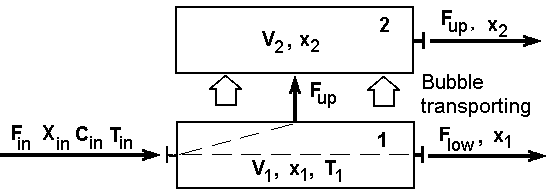
Fig.1. The representation of termoflotation apparatus as a double-cell
model with good mixing.
3. MATHEMATICAL MODEL
The mathematical model of an industrial termoflotator is devised at the following main assumptions:
- Termoflotator may be presented as a double- cell model with good mixing, the scheme of principal flows of which is shown in Fig.1;
- The basic component of the gaseous phase of bubbles is carbon dioxide;
- The amount of the transported solid phase component from the low part of the apparatus into the upper one is proportional to the effective quantity of bubbles.
The assumptions accepted are proved in (Arzamastsev, 1984; Arzamastsev et
al., 1985).
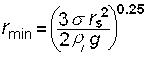
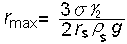
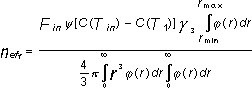
Only the bubbles having the radius from rmin to rmax
participate in the process of termoflotation (Arzamastsev, 1984). See equations
(1), (2):
|
|
(1) |
|
|
(2) |
The gas contents Cin in flow Fin (see fig.1) can be presented as a polynominal dependence (assuming that the dissolved gas is carbon dioxide):
|
Cin = 1.6516 - 5.1356 |
(3) |
 T
T or in a graphical form (Fig.2). Equation (3) is a result of approximation of CO2 solubility experimental data. If the suspension is heated from Tin up to T1 then according to Fig.2 there will be produced the amount of gas equal to D C due to its solubility decrease. The total amount of gas produced in a time unit is:
|
V = F iny (D C) = F iny [ C ( T in ) -C ( T 1 ) ] |
(4) |
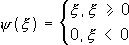
where  ()
is a certain function with the following properties:
()
is a certain function with the following properties:
|
|
(5) |
Let the dependence of distribution density of bubbles according to their
sizes be known- j (r). Then the total number of bubbles is:
|
|
(6) |
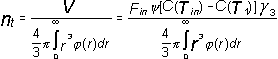
The effective number of bubbles is determined by the following equation:
|
|
(7) |
The equations of balances for the scheme presented in Fig.1 are:
|
V1 |
(8) |
|
V2 |
(9) |


The equation of total balance is:
|
F up + F low = F in |
(10) |
In static mode where dx1/dt= dx2/dt= 0 from the
quations (8) - (10) it follows that:
|
|
(11) |
|
|
(12) |
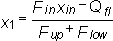
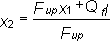
The member of equations (8) - (12) Q fl may depend on x 1
or not. It can be easily tested by comparing experimental and calculated
dependences for separation coefficient (a = x 2 / x in ).
In case of
|
Q fl = k 1 V 1 n eff |
(13) |
a is equal to:
|
|
(14) |
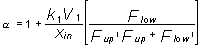
In case of
|
Q fl = k 2 V 1 n eff x 1 |
(15) |
a is equal to :
|
|
(16) |

Fig.3 shows that the first case does take place in practice. Equations (1)-(3),
(7), (11)-(14) are considered as a closed system which permits to calculate
biomass concentration in upper and lower flows according to T in and
T 1 . The model described is adequate to the process of
termoflotation in an industrial apparatus.
4. CONCLUSION
The model developed can be used together with the models of other
biotechnological processes (fermentation, drying, etc.) for all the
technological line optimization. Now it is used for the optimization of
bacterial biomass production from molassa malt substrate.
Termoflotation costs can be calculated according to the equation:
|
Costs=cF inr l( T 1 -T in ) E |
(17) |
However, these costs are not additional because after separation the
biomass is still dried by heating.
Termoflotation process does not allow to obtain high separation coefficients,
that is why its application is limited by those technologies which do not need
full biomass separation.
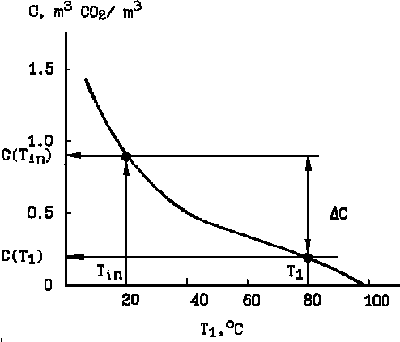
Fig. 2. CO 2 solubility in the microbiological suspension at
various temperatures.
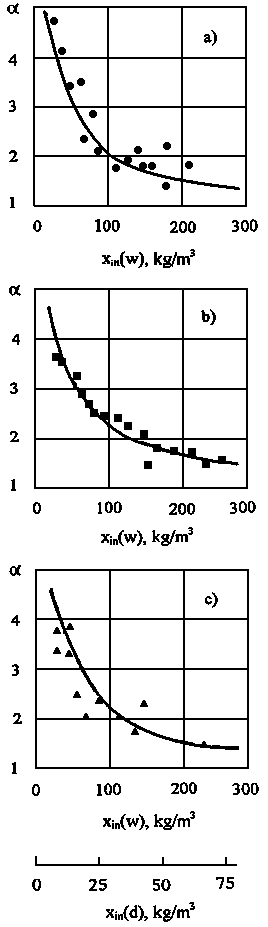
Fig.3. The dependence of separation coefficient (a ) on input biomass
concentration (x in ) at various temperatures of termoflotation.
Mean values correspond to: a) 75 - 79 o C; b) 80 - 84 o C;
c) 85 - 87 o C.
NOMENCLATURE
|
C |
gas contents of input flow; |
|
c |
specific heat capacity of liquid phase; |
|
E |
cost of 1kJ of energy; |
|
F |
input flow of suspension; |
|
g |
free downfall acceleration; |
|
k |
coefficient of the proportionality; |
|
n t |
total quantity of bubbles; |
|
n eff |
effective quantity of bubbles; |
|
Q fl |
kinetical member of termoflotation transport; |
|
r |
radius of bubble; |
|
r min |
minimum radius of bubble participating in the termoflotation process; |
|
r max |
maximum radius of bubble participating in the termoflotation process; |
|
r s |
radius of
the solid particle; |
|
T |
temperature of the liquid; |
|
t |
time of the process; |
|
V |
volume of the cell; |
|
x |
biomass concentration; |
|
|
Greek |
|
|
separation coefficient; |
|
|
the coefficients taking in account the deviations of the bubble form from a spherical one; |
|
|
the coefficient taking in account the real composition of gas in the bubbles; |
|
|
liquid phase density; |
|
|
solid phase density; |
|
|
surface tension of the liquid phase; |
|
|
Indexes |
|
1 |
lower cell of termoflotator; |
|
2 |
upper cell of termoflotator; |
|
in |
input flow of suspension; |
|
up |
upper flow; |
|
low |
lower flow. |

 1,
1,  l
l 
REFERENCES
- Arzamastsev, A.A.
(1984). Termoflotation separation of the microbial suspensions.
Fermentation and alcohol industry. 4, 28-31 (in Russian).
- Arzamastsev, A.A. (1988)
The rate of Pseudomonas endogenous respiration. Microbiologia. 57, 977-982
(in Russian).
- Arzamastsev, A.A., T.A.
Koldasheva and A.V. Firsov (1985). Some problems of organic materials
termoflotation. In.: Abstracts of the 7-th Reg. Conf. of the Spectroscopy,
74. Tambov Inst. Chem. Machine building, Tambov (in Russian).
ACKNOWLEDGEMENTS We thank eng. Rudi V.J. for organization
of experimental investigation, Niculshina N.L. for revision in English.
